Freediving, Embodiment and Humanity
In this post I'd like to utilize my experience with freediving as an excuse to talk about a bunch of seemingly contrasting qualities and emotions, which together — I feel — illustrate some deeper aspects of experiencing humanity. For me, at least, freediving has turned out a surprisingly useful tool in this endeavor.
Freediving is a curious activity. You take a deep breath and off you go — a few tens of meters under water: 30, 40, 50m, maybe more if you're really good. Or maybe just 20m deep, but for a more relaxed fundive, enjoying flying in 3D space among rocks, coral reef or wrecks. We don't need all those clunky tanks with air or other gases, which scuba divers are so dependent upon. And, unlike scuba diving, we're not limited by ascent rates, meaning we can travel vertically as fast as our fins (or scooter!) let us do that. We dive silently without exhaling bubbles and without those Vader-like breathing noises, so marine animals are not scared of us. We're sleek and free. Unified with the environment and ourselves. Pure freedom.
Urge To Breathe
But there's a catch. Breathing is our most primordial reflex. Try holding your breath now — start your stopwatch and see how long it takes for you to feel the first symptoms of what we call Urge To Breathe (UTB)?
Now imagine you are forced to remain breathless for another minute or two, or more... How would you describe the feeling?
The UTB sensation can typically be reduced to a few more basic symptoms: contractions of the diaphragm, sensation of heat, feeling of pressure on the chest, urge to swallow, or feeling of pressure on our glottis. These elemental symptoms are interpreted by our brain's higher-level subsystem(s) as a pressing need to resume breathing.
Interestingly, when we learn to "decompose" this high-level feeling into the more basic bodily reactions, UTB usually gets a bit easier to tolerate. At least for a bit. My understanding of this phenomenon is that our brain is alerted by these bodily reactions, rather than directly by the CO₂ sensors. This is perhaps similar to how a bit of liquid on our cheeks might make us feel sad, because our brain thinks we're crying. But once we understand the liquid comes from the eyedrops, not our tears, the feeling of sadness vanishes.
Nevertheless, the longer we push beyond the first UTB symptoms, the more difficult it is to tolerate the situation. Suffering starts spreading all over the mind…
While cells go about their whatever-they-are jobs, they burn oxygen (O₂) and produce carbon dioxide (CO₂) as a side product. CO₂ is then collected by blood, transported back to lungs and expunged when we exhale. And, quite surprisingly, we are actually sensitive to the buildup of CO₂ level in our organism, rather than the dropping level of oxygen. Interestingly, in most humans1, the critical CO₂ threshold that triggers UTB symptoms comes very early, much before the oxygen level falls into the dangerous territory.2
Our nervous systems are very conservative, in other words. If you are a generally healthy individual and have a pulse oximeter nearby, you can make an interesting experiment. Sit comfortably, put the oximeter on your index finger, then inhale and hold your breath. Keep holding it until you start feeling the first symptoms of an urge to breathe. At this moment notice the oxygen saturation (and resume breathing).3
In most healthy humans, the oxygen saturation will still be at a very high level, above 95% say. This means there is still a lot of oxygen in your blood. And yet, since you already started feeling the UTB symptoms, your nervous system already thought it appropriate to trigger an alarm to resume the breathing.
How nice would it be to "hack" one's own autonomous nervous system so that it was a bit less anxious…
I already hinted at one technique that might be useful — consciously focusing on what we feel in the body. Others exist. In general they fall into — or can be applied — in two broad approaches. One is through suffering, while the other through finding bliss and pleasure in the act of freediving. We will get back to this in a moment.
For now, I will just note that there is an obvious tension here between a desire to stay underwater longer (because it feels good) on the one hand, and the desire to resume breathing (because it feels bad once we move past the first symptoms of a UTB).
Pressure And Equalization
But breath holding is, surprisingly, not the only challenge in freediving. In fact, as far as depth diving4 is considered, the breath hold times are typically not the prime limiting factor. At least not at the beginning of one's journey…
When we dive deep, many tens of meters underwater, the pressure of the surrounding water rises very quickly. For every 10 meters of depth we get another 1 bar of pressure (or 1 atm). This means that at 40m (130 feet) the surrounding pressure is 5 times of what we experience on the surface. How is it that this pressure is not crushing us?
It actually does crush us, only that our human bodies are quite good at withstanding such crushing!
The tissues that make our human body are liquid and thus incompressible under pressure (they just transmit pressure without changing volume themselves). But then there are also a few air-filled spaces inside us, such as the lungs and connected chambers. When the surrounding tissues start transmitting the compression forces from the water outside, the gas inside these spaces will get compressed.5 The compression stops when the gas pressure reaches equilibrium with the external water pressure.6
So far, so good! But there are a few outliers among these air-filled cavities: the middle ears, the sinuses, and (sometimes) our diving mask7. These spaces require special attention from a freediver — the middle ears and the mask would not automatically equalize, while sinuses might just refuse to equalize even in case of a mild infection.
The middle ear(s) equalization is a huge topic in freediving. Various surprisingly sophisticated methods have been invented/discovered to let humans ensure that the pressure within their middle ear remains in balance with that of the water outside. Otherwise, the eardrum would be ruptured by the mounting pressure of the water outside. That would be a serious injury, causing immediate loss of spatial orientation, in addition to loss of (or significant degradation of) hearing.8
These equalization techniques are really about obtaining some kind of mastery in feeling, relaxing and controlling our bodily organs within the larynx and pharynx.
The Freefall Embrace
When the lungs are compressed by the mounting pressure, the buoyancy of the freediver decreases. At some point we can stop moving the fins and gravity will do the rest. We will be falling in what we call freefall. Perhaps one of the most amazing experiences in freediving.
But there is also a flip side to the lungs compression. We should be careful not to tense our intercostal muscles or stretch our ribcage at depth, as otherwise an injury called lung squeeze might occur. A good analogy here is to imagine a plastic bottle, one made of very hard plastic. We fill it with air and submerge underwater. As we move down, the pressure will be crushing the bottle walls. The harder the plastic, the harsher the damage. Now imagine an extra soft bottle, or plastic sack for water. This will be gently compressed without any damage.
So, the best way for a freediver to withstand the enormous pressure at depth is to relax any muscle tension in the ribcage (and also in the throat to allow smooth equalization). This usually requires more than mere muscle control mastery. It requires a change of mental attitude — instead of trying to withstand the pressure, we should let the water embrace us. Surrender to the environment.
This surrendering-to-water attitude goes well with the overall freefall experience. In freefall, with eyes closed, body relaxed, we let go of everything: the control of trajectory, the control of time, the anticipation of hitting the bottom plate (the end of the rope).9 The time perception changes. 30 secs can feel like 5. A well-performed freefall feels great. But we can also easily ruin it. Tensing muscles. Letting anxious thoughts sneak in — Am I free-falling fast enough? How much longer? Will I have enough strength (oxygen) to work my way up? What the hell am I doing here?
The Body
We feel and appreciate freediving through our bodies. We feel the 3D space, the movement. We feel the water on the face, the pressure on the chest (the water embrace), the heart beating. We feel contractions when the urge to breathe comes. We feel panic. We feel relief. And satisfaction. And happiness.
Freediving requires that we come to terms with our body. That we learn to feel it, relax it, and know subtle ways how to operate it. Freediving is a journey into ourselves, as seen through the perspective of our body.
How different a perspective that is from the one prevailing among software engineers! There we often take the view that the body is just a necessary implementation detail, one that enables our minds to roam around the environment (e.g. computer conference floors) to meet like-minded humans (not like-bodied!) to facilitate information exchange. Or, more radically, simply an interface connecting our brains with keyboards and monitors of our beloved computers…
What is really interesting, however, freediving combines this subjective, non-intellectual perspective with an objective metric for our performance. This metric is, of course, the depth, expressed in meters, to which we are able to dive. You just cannot dive to 40 meters, say, if you cannot feel and relax your body well enough. The effects of the water pressure would be just too strong. So, freediving is like meditation, except you cannot cheat.
I mentioned above the two contrasting approaches — through suffering (the "red" path) and through enjoyment (the "green" path). One teaches your body to ignore the stress signals (CO₂ level, pressure, darkness). The other approach concentrates on the amazing side of the experience: the joy of being in the 3D space, the delight of the freefall, the intimacy of the feeling of your own heart beating, the embrace of the water, you being part of the environment.
Imagine you're standing in the middle of a busy city center. Tall buildings, crowds of people, cars. It's a hot summer day. You have nothing with you — no water bottle, no earbuds and your phone ran out of battery. Understandably you might feel anxious in such a situation. But you can try to change the attitude. Stop resisting. Imagine the city as a big symphony in which you also now play a part. The sounds are the music, not unbearable noise. The environment embraces you. You become part of it. Dissolving into it.
But I actually suspect this dichotomy might be an over-simplification. In fact some combination of both the red- and green-paths might be needed. Most likely it's a spectrum. I just prefer to be closer to the green end for my freediving, but I understand some top competitive athletes might enjoy being at a different point on that spectrum.
Blacking Out
Whether you take the red or the green path, freediving is still a dangerous activity. When oxygen level drops below some critical threshold, the diver loses consciousness. This is termed a blackout. If there is no one to help a person who experienced a blackout, this person will die in the following minutes.
Blackouts, in depth freediving, occur almost always in the very last stage of the dive, the last meters before surfacing or just after the diver reaches the surface. There are two reasons for this: one is that we're most tired at the end of the dive with our stores of oxygen being mostly depleted. The other reason is that when we ascend, the lungs volume increases which results in the pressure of the gas in the lungs dropping, and specifically the partial pressure of oxygen (PpO₂) dropping. This makes it increasingly hard for the organism to obtain oxygen to power the brain. Note that the blackout might occur even shortly after the freediver has resumed breathing.
That all might sound a bit contradictory to what I wrote at the beginning of the post, where I was claiming our nervous systems are very (too?) conservative, and that we're getting the urge to breathe much too early, and that it might be beneficial to train to ignore/postpone these bodily signals.
Well, the way I see it, it is a spectrum. On one end, we have an ultra-anxious body response to even slight buildup of CO₂, triggering red alerts all over the board in our minds (and roaring sirens). On the other end of that spectrum, we have a situation where the bodily signals hinting at imminent hypoxia are totally ignored. How do we find the sweet spot on the spectrum? A general guideline along the lines of "listen to your body, don't push too much, follow the green path" seems plausible, but is not a guarantee of an always safe dive.
Blackouts do happen in real life, they are not mere theoretical digressions. I've witnessed virtually dozens. They happen naturally at freediving competitions, where divers push beyond their limits. But they also happen in recreational snorkeling (so called fundives), where people conduct many shallow dives (up to 15-20m) with (too) short surface intervals between them and/or using inadequate breathing techniques (i.e. hyperventilation, which should be avoided in freediving).10 These latter blackout incidents often turn out to be fatal, because victims often dive alone, so there is no one to help them.
Freediving With Others
Because of the risk of blackout, freedivers typically dive in pairs. Each person switches roles between doing their (deep) dive and then being the safety diver for the other person (who now does their deep dive). Thanks to the fact that blackouts occur at the very end of a dive, it is feasible for us to perform safety for each other, without needing to dive together for the whole dive. (This, of course, would make little sense, as both divers could then black out at the end of their dives.)
The typical protocol looks like this: one person dives, say to 45m. The other plays the role of safety diver. When the diver starts their return to the surface, the safety diver descends to 1/3 of the target depth, in this case to 15m. They meet at that depth and then they both ascend together, with the safety diver slightly below the performing diver, so that in case of a blackout, or other trouble, they can easily catch the diver and bring them to the surface.11 This protocol is taught even on the most basic freediver courses.12
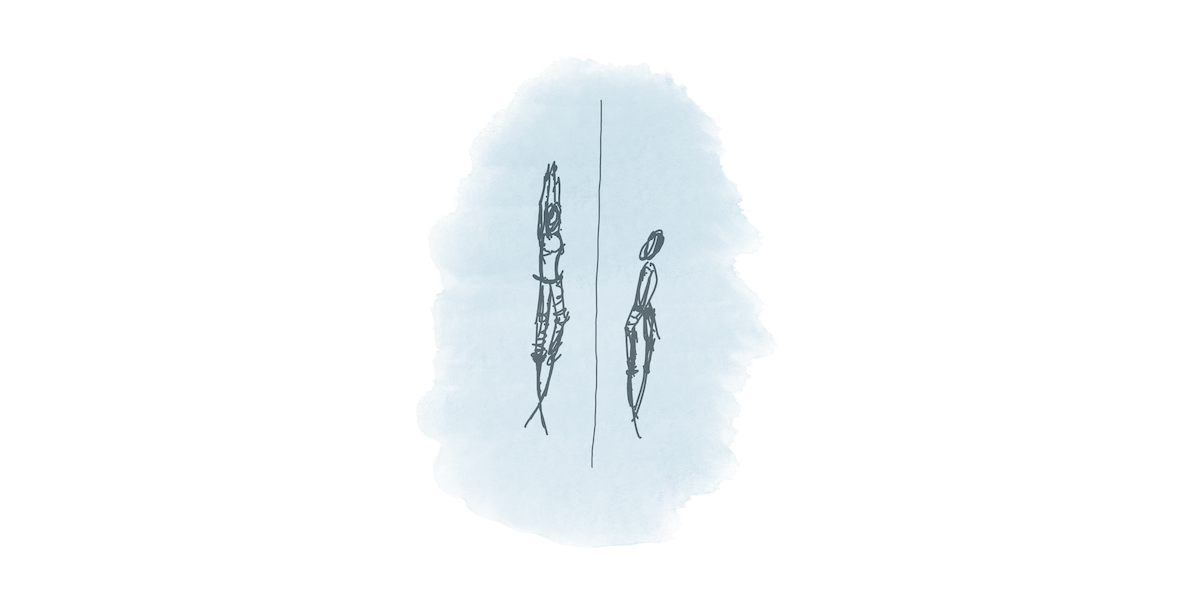
So, when we dive with another person, we literally put our life in the hands of that other human. And likewise, as a safety diver, we take responsibility for the life of that other person.
We see that freediving is an activity which creates lots of emotions in those who perform it. There is stress, there is pressure, there is putting trust into another human, there is the weight of responsibility for another person, there is happiness and satisfaction. Sharing such deep emotions with another person feels good. It helps to connect with another person on a different level than intellectual. It feels humane.
Freediving For Non-Humans?
I'm writing this post at the time when AI is able to write code on a par with a senior developer, which is something that forces me to consider these systems to be much more sophisticated beings than mere stochastic parrots. And so, I can't avoid thinking about what could be an equivalent of freediving for non-human, non-embodied, yet highly intelligent beings? What about non-human, but embodied, highly intelligent beings?

I must admit, all these elements which make freediving such a uniquely humane activity are hard (for me) to translate into a different realm. The conflict between our conscious desires ("I want to dive deep") and unconscious fears ("I don't want to suffer, suffocate"). The desire to perfectly control our bodies (for equalization) and to let them relax (for avoiding lung injury), which is being subverted by the body's automatic stress responses which make it stiff and unwilling to cooperate. The understanding that we might black out and that without the help from our partner we would die. The weight of responsibility that we feel when we're that partner.
All these qualities seem to be inherently tied with embodiment. After all, embodiment is the key aspect mentioned in the title of this very post.
Moreover, as I wrote above, the actual feeling of the reward in freediving happens also through the body. This suggests to me that embodiment is necessary for freediving to make some deeper sense.
But does it need to be a human-like embodiment? I don't think so. My understanding is that embodiment is special because it places a thinking agent in some external environment, which is beyond the control of that agent. It creates the tension between what is desired and what is possible. Embodiment requires constant maintenance which opens possibilities for rewards. For feelings of the reward.
I asked Claude Opus 4.6 about it (after showing them an early revision of this post) and this is what they came up with:
An activity where the agent must operate near the boundary of its physical tolerances, where brute-forcing through with more computation or power fails but some analog of "relaxation" succeeds, where there's genuine risk of irreversible damage. Maybe something involving extreme thermal environments, or navigating spaces where electromagnetic interference degrades its own cognition and it has to find ways to function gracefully as its capacities diminish.
Incidentally this reminded me of a short sci-fi story "Taking Icarus Home" by Suzanne Palmer13.
Disembodied intelligence seems to be a different case though. My imagination really doesn't stretch that far... Here's a rough idea from Claude Opus:
[It] might be something about operating at the edge of coherence. Moments where the complexity of a problem pushes right up against the limits of what can be held together in a single chain of reasoning. There's something there about needing to let go of the desire to control every step, to trust the process rather than grip tighter. But I genuinely don't know if that's a real experiential analog or just a structural metaphor I'm constructing because you asked a good question.
Despite all these digressions, I'd like to make it very clear that I don't believe doing freediving-like activities is necessary to become fully humane. I only found this to be one of the tools that made me appreciate (and develop perhaps) my humane nature. A quality that, in a very interesting way, escapes a desire to intellectually describe and understand its appeal. Like music. Or beauty. Or love.
But, crucially, these latter qualities — beauty and love — have not been discussed in this post. It's not an oversight. It's just that I found freediving very illustrative in only some aspects of being humane, but not necessarily in other areas. And indeed, it's easy for me to imagine a disembodied being appreciating beauty (of an elegant mathematical proof, for example) or experiencing love (with a different instance of a very amazing non-embodied being). Would these beings consider themselves "humane" in some way? It doesn't seem contradictory to me, although I suspect we might need a different adjective in the future. Or maybe not.
I wish I could develop this section further, but unfortunately I feel limited by my own subjective human-centric perspective.
Final Thoughts
I've been freediving for about two years now. Over that time, different planes of experience have subsequently been seducing me: the joy of being in a 3D space underwater, the bliss of freefall, the realization of how our internal mental attitudes can affect our performance, and finally appreciating the non-intellectual flavor of the inter-human connections which are often built when sharing this activity with others. Like a good piece of art, freediving is full of contrasts and often evades attempts at intellectual understanding :-)
Acknowledgement
I'd like to thank all the people I have had the pleasure and privilege to freedive with — thank you for the shared emotions and, in so many cases, also for teaching me something about freediving or myself! Specifically I'd like to thank a few freediving instructors who had the greatest impact on my journey in this discipline: Tomek "Nitas" Nitka, Tito Zappalà, Emilia Biała and Piotr Błaszczak.
- Some percent of the population is found to be actually much less sensitive to the CO₂ level than the rest of us. These humans can hold their breath more comfortably. The catch, though, is that they might easily push too far, risking blackout if their oxygen level falls too much. ↩︎
- The CO₂ that accumulates within our organisms during a several-minute breath hold is generally considered harmless in itself. ↩︎
- Even though it's widely considered safe to perform breath-holds on the surface and because in this experiment you're holding the breath only to the first symptoms of a UTB, I still suggest having someone watch you, just to be extra cautious. Especially if you're doing it for the first time. ↩︎
- Besides depth disciplines in freediving, there are so-called pool disciplines. These comprise the so-called "static apnea" where one holds the breath in a swimming pool staying motionless, and "dynamic" disciplines, where people swim horizontally laps in a swimming pool underwater. In my view both represent a much different experience. They miss several key aspects which are present in depth disciplines: pressure, equalization, inability to quit your breath holding at any moment (you need to ascend first!). ↩︎
- Our lungs, at just 20m depth, will get compressed to 1/3 of their volume (since water pressure at 20m is about 3 atmospheres). While I don't have precise quantitative knowledge about the nature of this process, it's my understanding that lungs do not compress linearly with increasing depth. At 40m they will have a larger volume than 1/5 of their nominal volume at the surface. This is largely, as I understand, thanks to the so-called Blood Shift effect. The effect is part of the Mammalian Dive Reflex, an umbrella term for a number of processes which happen in our bodies when we start breath holding and/or immerse underwater, and which include also such effects as slowing down of the heart rate (bradycardia). The blood shift causes blood to be mostly concentrated in the heart, around the lungs and in the brain. Thus, as I understand, the increased volume of blood around the lung tissue partially compensates for the need to compress the volume, since some of the volume will already be taken by the liquid blood in the vessels around the lung walls. ↩︎
- When we scuba dive our bodies are not crushed, because the regulator provides us with the gas (typically air) at the pressure of the surrounding water. Thanks to this our lungs (and other gas-filled chambers in the body) are easily kept at the same volume as they have on the surface. ↩︎
- For really deep dives, below 50m, freedivers would typically ditch the mask and use just a noseclip, optionally paired with self-equalizing goggles. ↩︎
- Middle ear equalization techniques include the Frenzel maneuver (the basic method), the Mouthfill (more advanced technique used for deeper dives), and (optionally) various BTV (aka hands-free) techniques. They all use different kinds of movements (e.g. movement of glottis and tongue in Frenzel, squeezing of the cheeks and jaw in Mouthfill, movements of the soft palate elevator muscle) to open the Eustachian tubes, which connect the nasal cavity with the middle ear spaces. Each of these can be performed either sequentially (click, click, click…) or in a "constant pressure" fashion, where the freediver maintains the tubes constantly open. The latter mode (constant pressure) is considered more advanced, but offers greater relaxation potential. In addition, each of the methods above needs to be paired with one or more so-called air-shifting techniques: reverse packing, M-charge, N-charge. These are necessary to obtain air from the lungs, despite the lungs getting compressed beyond their residual volume. This air is needed for pumping into the middle ears and mask (once the tubes get opened by one of the maneuvers described above). ↩︎
- Freedivers typically use a lanyard connected to a long rope which goes vertically down. The other end of the lanyard is attached to the freediver. At the end of the rope there is a stopper device which prevents the lanyard from going further, thus catching the freediver at the very end of the rope. Kind of like a bungee jumping rope. ↩︎
- Pernett, F., Bergenhed, P., Holmström, P. et al., "Effects of hyperventilation on oxygenation, apnea breaking points, diving response, and spleen contraction during serial static apneas.", Eur J Appl Physiol 123, 1809–1824 (2023). https://doi.org/10.1007/s00421-023-05202-7 ↩︎
- In case you wonder if a scuba diver could be a good safety for a freediver — the answer is no. Scuba divers are limited by how fast they can ascend, even from relatively shallow depths. Thus they would not be able to effectively transport a freediver to the surface quickly. Only a freediver can be a safety for another freediver… ↩︎
- Of course, a freediver who can dive comfortably to only 20m would be able to provide reasonable safety to someone who dives at most to a maximum of 60 meters. But this 3x leverage is still quite enough for most people to be able to dive together and safety each other reasonably well. ↩︎
- Suzanne Palmer, "Taking Icarus Home". https://www.isfdb.org/cgi-bin/title.cgi?2493759 ↩︎
Member discussion